
Koasa Trail Stage 3
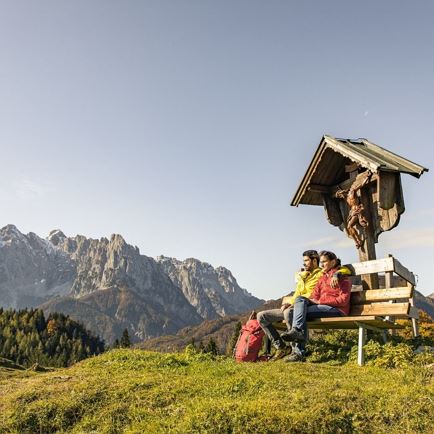

The name "Teufelskapelle" already indicates the legendary place where the sacred gem lies in a field slightly above the road between Gasteig and Griesenau. According to oral tradition, the unique structure of this wooden chapel on a rock block, to which a masonry wayside shrine is attached, is said to be nearly 500 years old. However, much suggests that the chapel was likely built only in the 18th century. A monogram "A.C." with the year "1737" inside could be related to the time of its construction. In the church records of the parish, the name appears for the first time in 1750 as "Jöchlsteinerkapelle nebst Griesenau."
Answers to possible reasons for the construction at this extraordinary location and the name of the chapel have been sought by the local population in oral tradition through various legends. In all these explanatory legends, the figure of the devil plays a role.
Beda Weber already recounts in 1837 a tale which states that the chapel was built on the isolated rock "after a wicked little devil had been banished from the place, who teased and mocked the passing churchgoers." A second version, also known in nearby Kössen, tells of a girl who was insatiably eager to dance. She ended up dancing with the devil, whose animal feet became visible when she was led to this chapel with the dancer. According to another story, the devil wanted to prevent a peasant woman from building a chapel in honor of the Virgin Mary as a thanks for surviving an illness and angrily hurled a mountain peak from the Kaiser Mountains onto the construction site. However, through the peasant woman's prayers, the rock only descended slowly and pushed into the ground as if it had been placed there. As a token of gratitude, the chapel was then built.
In any case, it is striking to see an attempt to interpret a cult site that seems at least ancient through the baroque art and Christian beliefs of the time. A comparison and kinship between the rock sanctuary and that of Maria Stampfanger near Söll cannot be discounted.
The chapel is constructed as a post structure with vertical wooden cladding, a recessed, straight-closing altar niche, and a curved, shingle-roofed tent roof and is accessed via a staircase that leads up to the rock in natural stone masonry. The wooden cladding was largely renewed in 1983 during the last restoration of the chapel. Through a simple, rectangular wooden door, one enters the worship space, whose walls are painted with a red brick pattern. Unfortunately, most of the originally very rich inventory has been stolen. Only from literature do we know of three votive paintings from the 18th century, which, however, again allow conclusions about the baroque origin of the chapel: One representation was Christ on the Mount of Olives, the other two (dated 1729 and 1743) were dedicated to the Altöttinger Gnadenmadonna. When the furnishing of the chapel was restored in 1957 by Peter Thaler from St. Johann in Tirol, the two panels from 1729 and 1743 had already disappeared. The altar figure of the Black Madonna of Altötting (unusually with a white face) was also no longer present at that time and had been replaced by the Heart of Jesus image that is still visible today in the blue-painted altar niche behind the baroque honeycomb lattice. The third votive painting and another from the year 1865 with a depiction of Maria Hilf must have been lost shortly thereafter. Of the baroque cycle of paintings on wood under the tent roof, only the central depiction of St. Michael as a soul-weigher has survived in its original form. The other four scenes (Annunciation of Mary, Nativity of Christ, Flight into Egypt, Holy Transformation) were newly created during the restoration of 1957 by Berta Thaler, the daughter of Peter Thaler from St. Johann in Tirol, based on motifs by Giotto. However, these depictions were also stolen, and today only the copies painted according to photographic templates by the Kitzbühel restorer Hermann Mayr remain.
At the foot of the rock block, the masonry niche shrine with a shingle-roofed gable roof and a wooden balustrade is built in front of the segment-arched niche. In 1977, during the renovation of the shrine by the owning family, the crucifix in the niche was newly crafted in place of the stolen one.
Literature reference: Dorfbuch Kirchdorf in Tirol
Read more
Opening hours and contact
Contact
Griesenau, 6382 Kirchdorf in Tirol
Plan route