
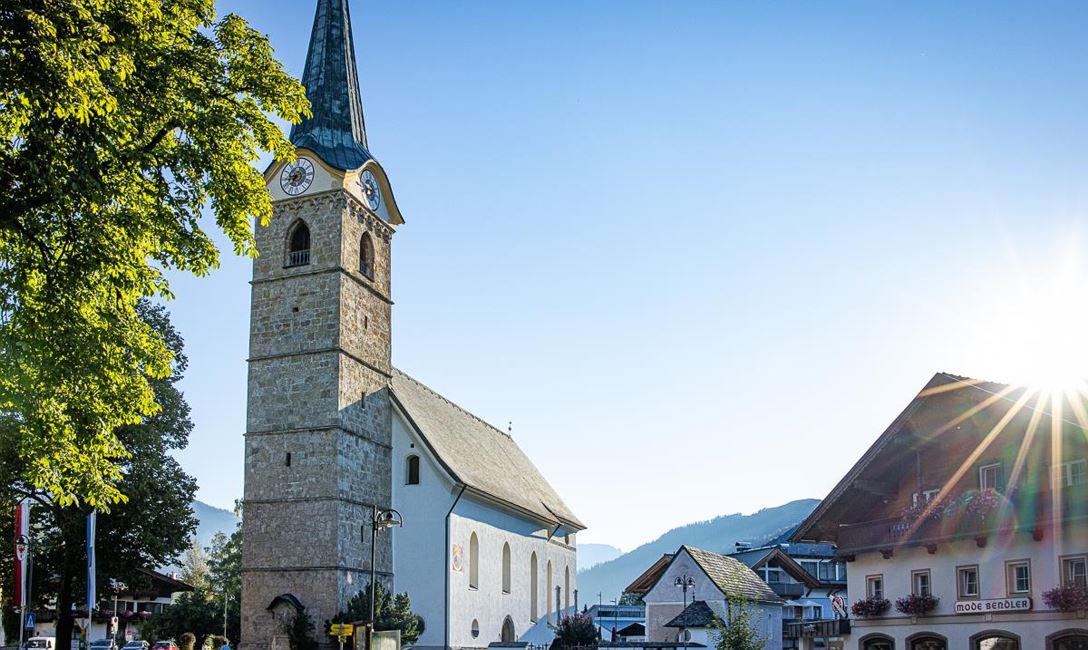


The present parish church of St. Stephen stands prominently in the village square and was most recently restored in the years 1986/87/89. The massive six-story tower with its soaring spire is followed by the simple three-aisled nave with an adjacent choir and a two-story sacristy on the north side. A pointed west portal and a late Gothic south entrance open up the interior of the church.
The very name of the village "Kirchdorf" indicates that this settlement is ancient cultural ground and can point to a centuries-long church history. Thus, the first church built in the 8th century was constructed over a profane building from the Roman imperial period (around ca. 400 a.m.). Around 800, the early medieval church was built, followed by the Romanesque church in 1200 and the late Gothic church in 1510. In the middle of the 18th century, it was baroque in style. In 1816, the interior of the church was redesigned in a classical style.
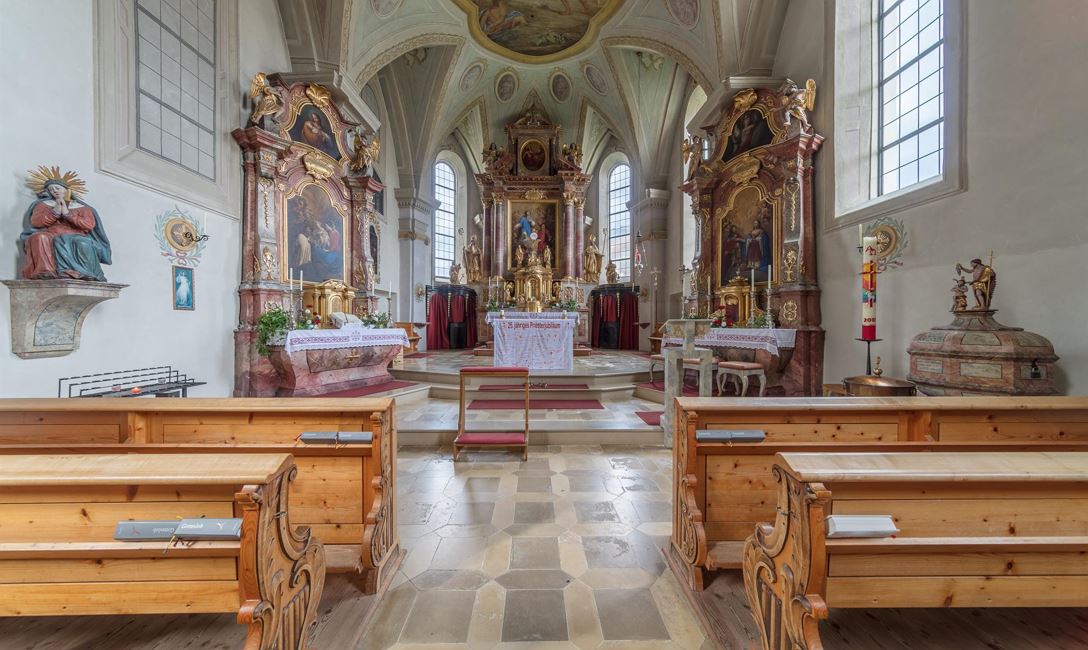
The ceiling frescoes by Josef Schöpf from 1816 depict in the choir the stoning of the church patron St. Stephen, in the nave the handing over of the scapular to St. Simon Stock by Mary, and above the organ gallery, the second patron of the church, St. Lawrence, as an intercessor over the village between Emperor Henry II and Kunigunde.
The high altar with double columns and pediment made of marble and the gilded carvings, capitals, and the tabernacle were created by Johann Schweinester in 1836.
The gilded figures of Rupert and Virgil and the angels at the altar, as well as the figures of Peter and Mary Magdalene on the two confessionals, come from St. Johanner Josef Haid.
The paintings of the altars were done by Johann Endfelder – on the high altar, the two church patrons Stephen and Lawrence and the Holy Trinity.
The octagonal baptismal font in the presbytery recalls the fire in the year 1809.
The tombstone of Provost Erasmus Sibenpekh (pastor in Kirchdorf from 1536-1553) in the basement of the tower is considered one of the most important funerary monuments of the Renaissance in Tyrol.